
Commentary
UEFA is helping solve fan travel measurement. What should clubs do next?
A more consistent approach to measuring spectator travel gives football a stronger foundation. The next challenge is turning that data into action, and ultimately changing how supporters travel.
7 September 2026 · 7 min read · By Will Line, CEO
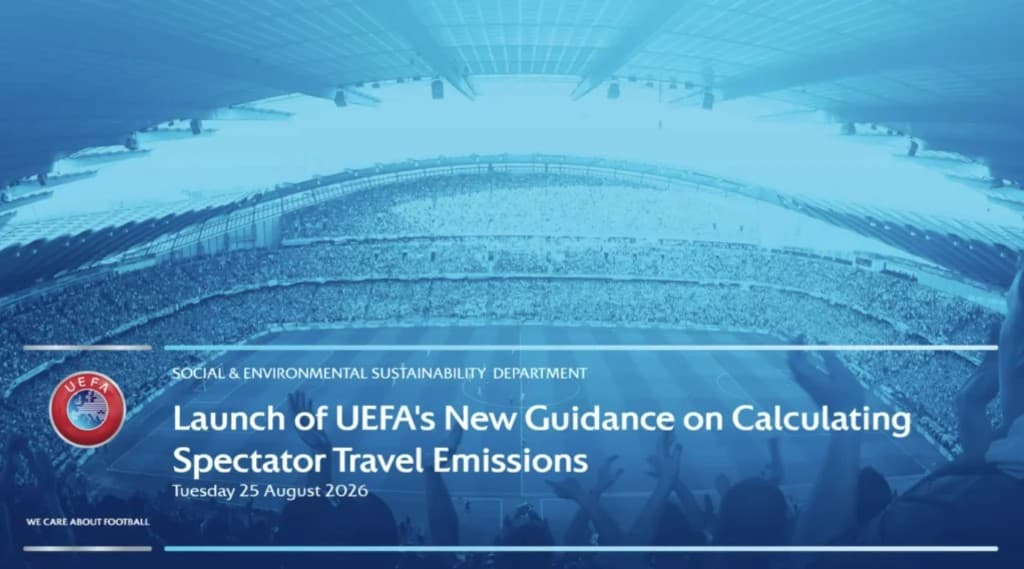
Football took an important step forward on spectator travel this week.
More than 100 representatives from football and the wider sports industry came together at a UEFA-hosted workshop focused specifically on spectator mobility. Alongside the workshop, UEFA launched new guidance, developed with the Premier League, LFP and DFL, aimed at creating a more consistent methodology for calculating spectator travel emissions.
That represents meaningful progress for an area that has historically been difficult to measure consistently.
Spectator mobility can account for between 40% and 70% of a football organisation's Scope 3 emissions, yet different methodologies, limited data and varying levels of supporter participation have made it difficult for clubs to build a clear and comparable picture of their impact.
Greater consistency should give the industry a much stronger foundation.
The opportunity now is to build on that foundation.
Because ultimately, better measurement is not the end goal. The real value comes from using that data to make better decisions, introduce more effective interventions and, over time, change how supporters travel.
From measurement to action
Better travel data can help clubs understand where supporters are travelling from, which modes they are using, how far they are travelling and how those patterns change between fixtures.
That information becomes much more valuable when it starts influencing what a club actually does.
Instead of approaching sustainable travel by asking which initiatives could be introduced, clubs can begin by identifying where there is the greatest realistic opportunity to change behaviour.
That creates a much more focused starting point.
Broadly, there are three ways clubs can begin turning better travel data into meaningful action.
1. Identify where behaviour change is most achievable
Not every supporter journey presents the same opportunity for change.
A supporter travelling hundreds of miles from a rural location will have very different alternatives to somebody driving a short distance from an area well served by public transport.
Understanding those differences allows clubs to focus their efforts where an intervention is most likely to have an impact.
For example, a concentration of car journeys from a particular location could provide the case for a new shuttle service. Large numbers of relatively short car journeys might point towards an opportunity for car sharing, cycling or walking. Low rail usage from areas with strong connections could suggest that cost, awareness or convenience is the greater barrier.
Fixture-by-fixture differences can also reveal where particular challenges are emerging, whether that is unusually high parking demand, limited public transport availability or changing arrival patterns.
The important point is that the starting point becomes the behaviour itself.
Rather than introducing initiatives broadly and hoping they work, clubs can use the data to identify where change is both possible and worthwhile.
2. Match the intervention to the problem
Once an opportunity has been identified, the next step is understanding what is preventing supporters from travelling differently.
Sometimes the barrier will be cost. In other cases, it may be limited availability, poor awareness, a lack of confidence in an alternative, or simply the fact that the existing transport option does not fit the realities of the matchday journey.
That means the right intervention will vary.
It could be a discounted rail ticket, a new shuttle route, a car-sharing initiative, a change to parking policy, more targeted communications, or an incentive to encourage supporters to try a different mode of transport.
In some cases, the solution may sit outside the club altogether and require closer collaboration with transport operators or local authorities.
Better data helps make those decisions more targeted.
Rather than attempting to introduce every possible sustainable travel initiative, clubs can identify a specific challenge, introduce an appropriate intervention and build an evidence base around what works for their supporters and their venue.
In its simplest form:
Understand → Identify → Intervene → Measure → Improve
That creates a repeatable process rather than a collection of disconnected initiatives.
3. Measure behaviour change, not just participation
This is where the distinction between measuring activity and measuring impact becomes particularly important.
A club might know that 500 discounted train tickets were claimed, that 1,000 supporters used a new shuttle service or that a campaign reached 20,000 people.
Those are all useful measures of engagement and uptake.
But they do not necessarily demonstrate that behaviour changed.
Take the example of 500 discounted train tickets. On its own, that tells the club that the intervention was used. It does not reveal how many of those journeys replaced car journeys, how many supporters would already have travelled by train, or whether those supporters continued travelling more sustainably at future fixtures.
The same principle applies to any intervention.
A successful shuttle service is much more meaningful if it can be shown to have reduced private car journeys. A well-engaged campaign becomes more valuable if it leads to a measurable shift in travel behaviour. And an incentive becomes particularly powerful if that change continues after the incentive itself has been removed.
That requires clubs to understand supporter travel over time rather than looking at individual fixtures or campaigns in isolation.
The aim should be to create a feedback loop that links interventions directly to outcomes: what was introduced, who it influenced, what behaviour changed and whether that change lasted.
That is how clubs can move from reporting activity to demonstrating genuine impact.
The opportunity goes beyond sustainability
There is another reason why this matters.
The same supporter journey that creates an emission also creates a matchday experience.
Where supporters travel from, the routes they use and when they arrive can influence congestion around a stadium, parking demand, public transport capacity, stewarding requirements and how long supporters spend in and around the venue.
Better fan travel intelligence therefore has value far beyond an annual Scope 3 calculation.
It can help sustainability teams understand and reduce emissions. It can help operations teams better understand crowd movement and arrival patterns. It can help fan experience teams identify friction in the journey. And it can give clubs stronger evidence when working with transport operators and local authorities to improve provision.
That broader value is important because the strongest case for improving fan travel may not come from sustainability alone.
If better travel decisions can simultaneously reduce emissions, improve the supporter experience and make matchday operations more effective, the incentive for clubs to act becomes much stronger.
The next phase of spectator travel
UEFA's new guidance gives football a stronger common foundation for understanding spectator travel.
The next phase is about what clubs do with it.
Those that move fastest will begin identifying where behaviour change is achievable, testing targeted interventions and building a clearer understanding of what genuinely influences how supporters travel.
Over time, that evidence should make sustainable fan travel easier to deliver.
Clubs will be able to move away from implementing initiatives based largely on assumption and towards a much more evidence-led approach, understanding the problem, choosing the right intervention and then demonstrating whether it worked.
For a long time, the industry has been working to answer:
How do our fans travel?
UEFA's work is helping football answer that question more consistently.
The opportunity now is to move onto the one that matters next:
What can we do that actually changes how our fans travel?
More articles
The fan experience doesn't start at the turnstile
Supporters will endure an extraordinary amount to be there. What they will not forgive is being left with nothing when it goes wrong.
Read article
Children's lungs grew faster after ULEZ. What that tells us about behaviour change, and what comes next
The CHILL study closed a loop that policy debates usually leave open. The interesting question is what actually changed.
Read article
The Sporting Events Bill: what it actually means for the people who run events
The way major sporting events plan fan transport is about to get a statutory framework.
Read article

Your smarter
way to move
© 2025 Staxy Ltd.